

[Thai version below]
Electric two-wheelers (E2Ws), including electric motorcycles and scooters, have become one of the fastest-growing segments in the global electric vehicle market. According to the Global EV Outlook 2026 by the International Energy Agency (IEA), electric two- and three-wheelers remained the most electrified road transport segment in the world in 2025.
Global sales of electric two- and three-wheelers reached around 11 million units in 2025, representing approximately 15% of total global sales in this segment. Around 10% of the global two- and three-wheeler fleet is now electric.
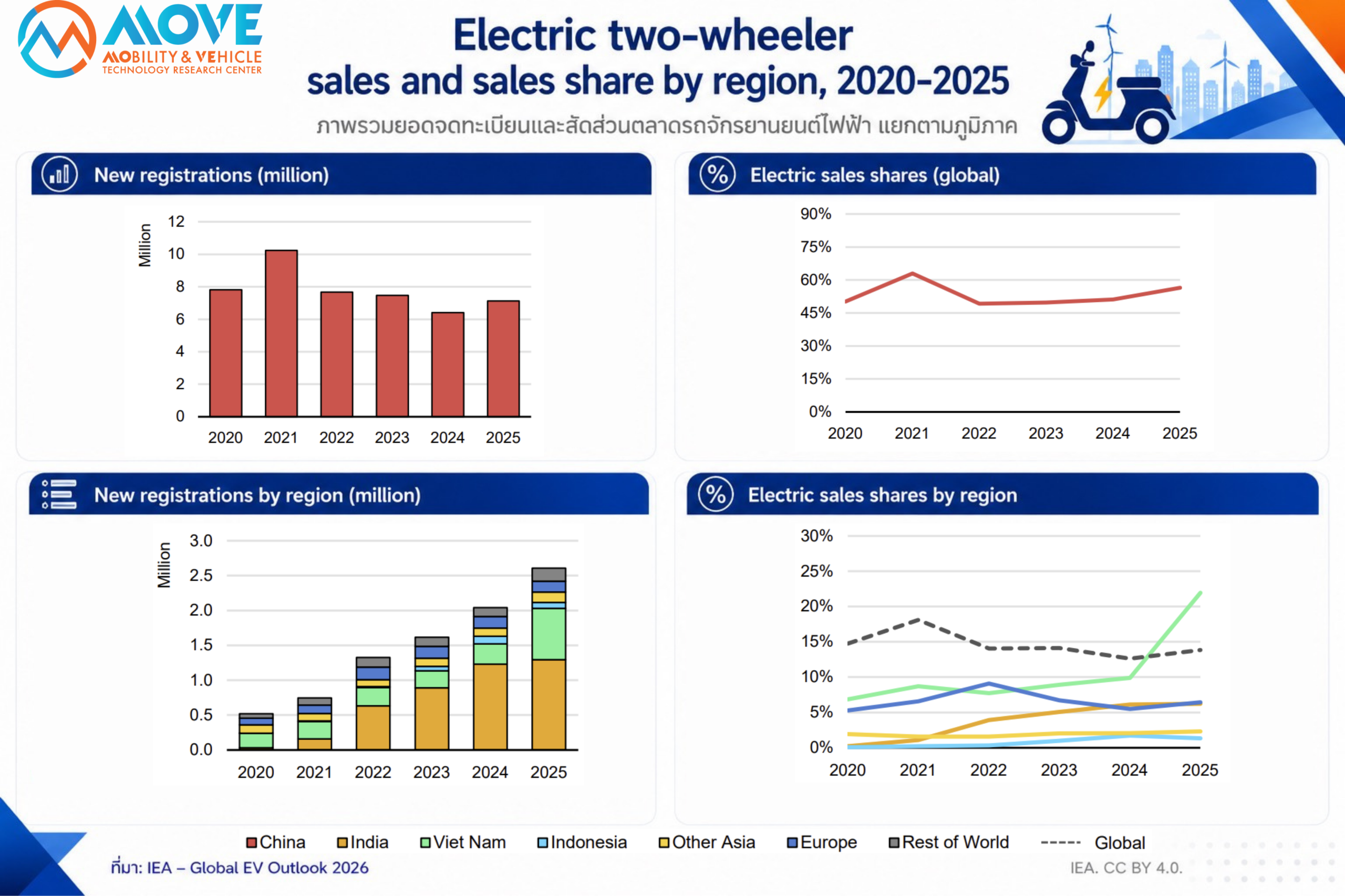
Figure highlights the changing landscape of electric two-wheeler adoption across regions between 2020 and 2025. China remains the world’s largest market, accounting for more than 7 million electric two-wheeler sales in 2025. Although sales growth in China has slowed compared with earlier years, electric motorcycles and scooters still represented more than 55% of total two-wheeler sales in the country.
One of the most important developments in recent years has been the rapid expansion of electric two-wheelers in Southeast Asia, especially in Viet Nam. Sales in Viet Nam more than doubled to approximately 735 000 units in 2025, making the country one of the fastest-growing electric motorcycle markets in the world. Electric models now account for more than 20% of total motorcycle sales in Viet Nam. Local manufacturers such as VinFast and Pega, together with Chinese brands like Yadea and Dibao, have intensified market competition through promotional campaigns, trade-in programmes, and affordable pricing strategies.
India also remains a major global market for electric two-wheelers, with sales reaching nearly 1.3 million units in 2025. However, growth slowed compared with previous years due to reductions in government subsidies and changes in tax policies. Under the new PM E-DRIVE policy, financial support for electric motorcycles became significantly lower than under earlier programmes, reducing price competitiveness against conventional gasoline motorcycles.
Meanwhile, Indonesia experienced a decline in electric motorcycle sales in 2025 after subsidy programmes ended in late 2024. This demonstrates how strongly policy support influences EV adoption in emerging markets.
Outside Asia, Africa is becoming an increasingly promising market for electric motorcycles, particularly in countries such as Uganda and Kenya. In these countries, electric motorcycles are widely used for ride-hailing, motorcycle taxis, and delivery services because electricity costs are much lower than gasoline prices. Battery-swapping systems and innovative financing models are also helping accelerate adoption.
Overall, electric two-wheelers are playing a crucial role in accelerating global transport decarbonisation. Compared with electric cars, electric motorcycles are generally more affordable, consume less energy, and are especially suitable for urban mobility in developing economies. As governments continue strengthening climate policies and air pollution regulations, the global electric motorcycle market is expected to expand even further over the coming decade.
(Reference: International Energy Agency. (2026). Global EV outlook 2026. https://www.iea.org/reports/global-ev-outlook-2026)
รถจักรยานยนต์ไฟฟ้ากำลังเปลี่ยนโลก EV อย่างไร?
รถจักรยานยนต์ไฟฟ้า (Electric Two-Wheelers: E2Ws) กำลังกลายเป็นหนึ่งในกลุ่มยานยนต์ไฟฟ้าที่เติบโตเร็วที่สุดของโลก โดยรายงาน Global EV Outlook 2026 ของ International Energy Agency (IEA) ระบุว่า รถจักรยานยนต์และรถสามล้อไฟฟ้ายังคงเป็นกลุ่มยานยนต์ที่มีสัดส่วนการใช้พลังงานไฟฟ้าสูงที่สุดในโลกในปี 2025
ยอดขายรถจักรยานยนต์และรถสามล้อไฟฟ้าทั่วโลกเพิ่มขึ้นแตะประมาณ 11 ล้านคันในปี 2025 คิดเป็นประมาณ 15% ของยอดขายรถประเภทนี้ทั้งหมดทั่วโลก และปัจจุบันประมาณ 10% ของรถสองล้อและสามล้อทั่วโลกเป็นรถไฟฟ้าแล้ว
จากภาพจะเห็นได้ว่าตลาดรถจักรยานยนต์ไฟฟ้าของโลกกำลังเปลี่ยนแปลงอย่างรวดเร็วในหลายภูมิภาค โดยจีนยังคงเป็นตลาดที่ใหญ่ที่สุดของโลก ด้วยยอดขายมากกว่า 7 ล้านคันในปี 2025 และมีสัดส่วนยอดขายรถไฟฟ้ามากกว่า 55% ของตลาดรถจักรยานยนต์ทั้งหมดในประเทศ
อย่างไรก็ตาม ประเทศที่น่าจับตามองมากที่สุดในช่วงไม่กี่ปีที่ผ่านมา คือ “เวียดนาม” ซึ่งกลายเป็นตลาดรถจักรยานยนต์ไฟฟ้าที่เติบโตเร็วที่สุดแห่งหนึ่งของโลก ยอดขายเพิ่มขึ้นมากกว่าสองเท่า แตะประมาณ 735,000 คันในปี 2025 ส่งผลให้รถไฟฟ้ามีสัดส่วนมากกว่า 20% ของยอดขายรถจักรยานยนต์ทั้งหมดในประเทศ
การเติบโตดังกล่าวได้รับแรงสนับสนุนจากผู้ผลิตท้องถิ่น เช่น VinFast และ Pega รวมถึงแบรนด์จากจีนอย่าง Yadea และ Dibao ที่แข่งขันกันอย่างเข้มข้นผ่านการลดราคา โปรโมชั่น และโครงการ trade-in
ด้านอินเดีย แม้ยังเป็นตลาดรถจักรยานยนต์ไฟฟ้าขนาดใหญ่อันดับต้น ๆ ของโลก โดยมียอดขายเกือบ 1.3 ล้านคันในปี 2025 แต่การเติบโตเริ่มชะลอตัว เนื่องจากรัฐบาลลดระดับเงินอุดหนุนภายใต้นโยบาย PM E-DRIVE เมื่อเทียบกับโครงการเดิม ส่งผลให้รถไฟฟ้ามีความสามารถในการแข่งขันด้านราคาลดลงเมื่อเทียบกับรถใช้น้ำมัน
ขณะที่อินโดนีเซีย ซึ่งเป็นตลาดรถจักรยานยนต์ขนาดใหญ่ที่สุดในอาเซียน กลับมียอดขายรถไฟฟ้าลดลงในปี 2025 หลังโครงการสนับสนุนจากภาครัฐสิ้นสุดลงในปลายปี 2024 สะท้อนให้เห็นว่านโยบายภาครัฐยังคงเป็นปัจจัยสำคัญต่อการเติบโตของตลาด EV ในประเทศกำลังพัฒนา
นอกเหนือจากเอเชีย ทวีปแอฟริกาก็กำลังกลายเป็นตลาดใหม่ที่น่าสนใจ โดยเฉพาะในประเทศอย่างยูกันดาและเคนยา ซึ่งรถจักรยานยนต์ไฟฟ้าถูกนำมาใช้ในบริการ ride-hailing รถรับจ้าง และบริการส่งสินค้า เนื่องจากต้นทุนค่าไฟฟ้าต่ำกว่าค่าน้ำมันอย่างมาก นอกจากนี้ ระบบสลับแบตเตอรี่ (battery swapping) และรูปแบบการผ่อนชำระรายวัน ยังช่วยให้ประชาชนเข้าถึงรถไฟฟ้าได้ง่ายขึ้น
โดยรวมแล้ว รถจักรยานยนต์ไฟฟ้ากำลังมีบทบาทสำคัญต่อการลดการปล่อยก๊าซเรือนกระจกในภาคขนส่งทั่วโลก เพราะมีราคาถูกกว่ารถยนต์ไฟฟ้า ใช้พลังงานน้อยกว่า และเหมาะสมกับการเดินทางในเมือง โดยเฉพาะในประเทศกำลังพัฒนา ซึ่งรถจักรยานยนต์ยังคงเป็นพาหนะหลักของประชาชนจำนวนมากทั่วโลก
(อ้างอิง: International Energy Agency. (2026). Global EV outlook 2026. https://www.iea.org/reports/global-ev-outlook-2026)